
Beechcraft Aircraft Insurance Specialists
Tailored cover for Beechcraft owners, operators, flight schools, and commercial fleets.
Beechcraft aircraft have long held a strong position in Australian aviation, from privately owned Bonanzas to turbine-powered King Air fleets operating across regional and remote Australia. Getting a Beechcraft insured is not just about nominating a hull value and selecting liability limits. These aircraft vary significantly in performance, complexity, operating environments, and pilot requirements.
At AGL Aviation Insurance Brokers, we arrange specialist Beechcraft insurance for owners and operators who want properly structured protection backed by aviation-focused advice.
So, whether you operate privately, conduct flight training, run charter services, or manage a multi-aircraft commercial fleet, we customise coverage to reflect how your aircraft is actually flown, and not on how a generic policy assumes it is.
Insurance Tailored for Beechcraft Aircraft
Beechcraft aircraft cover a wide spectrum of general aviation and commercial operations. From high-performance piston singles to pressurised turboprops, each model presents a distinct underwriting profile that requires thoughtful insurance structuring.
These aircraft are often used more intensively than basic trainers, operating longer legs, carrying passengers, and flying IFR. Their build quality and systems complexity contribute to higher asset values and, in turbine variants, significant engine and maintenance costs. All of these factors directly influence aircraft insurance considerations.
AGL Aviation has arranged cover for privately owned piston Beechcraft aircraft through to complex multi-engine turbine fleets. We understand the underwriting expectations around pressurised cabins, multi-crew operations, turbine engine programs, and commercial utilisation.
Our experience enables us to anticipate insurer queries and present risks clearly and accurately, thereby streamlining placement and helping secure competitive terms. Beechcraft aircraft often sit at the intersection of general aviation and commercial transport, an area where specialist knowledge matters.


Why Beechcraft Aircraft Insurance Is Essential
Operating a Beechcraft aircraft comes with financial and legal exposure that extends beyond the value of the aircraft itself.
A Beechcraft Bonanza flown privately from a capital city aerodrome presents a very different risk profile to a King Air operating daily charter services into regional strips. Underwriters look closely at usage type, pilot qualifications, hours on type, maintenance standards, and operating environment.
Turbine aircraft demand stricter pilot minimums and higher liability limits. Even within piston models, retractable gear, multi-engine configurations, and advanced avionics affect pricing and policy structure. Tailored insurance ensures that your Beechcraft coverage reflects these operational realities rather than applying assumptions that may leave gaps.
▶ Protection against accidents, damage, and liability
Hull insurance protects against accidental physical loss or damage during flight, taxiing, or while on the ground. For higher-value aircraft like King Air turboprops, repair costs can quickly escalate due to parts pricing and specialist maintenance requirements. Liability insurance protects against claims arising from passenger injury, third-party property damage, or ground incidents. In Australia, even minor incidents can lead to high legal costs, making adequate liability limits a central part of any Beechcraft policy.
▶ Compliance with Australian aviation requirements
Commercial Beechcraft operations must meet Civil Aviation Safety Authority (CASA) requirements for liability coverage. Charter and hire-and-reward operators, in particular, must maintain appropriate passenger liability limits aligned with regulatory obligations and contractual requirements. Even private operators may need proof of insurance to access certain aerodromes or enter lease agreements. Structured correctly, insurance supports both regulatory compliance and contractual commitments.
▶ Peace of mind for owners, pilots, and businesses
A Beechcraft aircraft represents a significant capital investment and, for many operators, a revenue-generating asset. Insurance reduces the financial shock of unexpected damage or liability claims and allows operators to focus on safe and efficient flying. For commercial fleets, insurance also supports business continuity by funding repairs or replacement following a covered event.
Models of Beechcraft Aircraft We Typically Insure
Beechcraft’s product line spans piston singles, twin-engine aircraft, and turbine-powered platforms widely used across Australia. Each model comes with different performance capabilities, maintenance considerations, and underwriting requirements.
We regularly arrange insurance for a broad range of Beechcraft models, from privately owned Bonanzas and Barons through to King Air variants used in charter, freight, and aeromedical roles. The following table outlines the aircraft types we typically insure and their general operational characteristics.
| Beechcraft Aircraft Category | Common Models | Typical Use & Coverage |
|---|---|---|
| Single-Engine Piston | Beechcraft Bonanza (e.g., G36) |
• Primary choice for private owners and advanced personal flying. • Used for cross-country and IFR operations when appropriately endorsed. • Coverage typically includes hull, liability, passenger liability, and hangar/ground risk. • Underwriters emphasise pilot experience in high-performance singles. |
| Twin-Engine Piston |
Beechcraft Baron series (e.g., 58, G58) Beechcraft Travel Air |
• Popular for owner-flown twin operations, training, or light charter where approved. • Used for private travel, flight instruction, and small business use. • Coverage includes liability, hull, passenger, transit, and loss-of-use options. • Experience and multi-engine ratings are often required. |
| Twin-Engine Turboprop | Beechcraft King Air family (e.g., King Air 90, 200, 300/350/360) |
• Designed for corporate travel, charter (where permitted), air-ambulance/medevac, freight, and private business use. • Coverage commonly includes high-limit liability, hull (agreed value), crew and passenger benefits, and optional medevac/charter wording. • Insurers require formal type experience, operational profile review, and higher liability limits. |
What Beechcraft Aircraft Insurance Can Cover
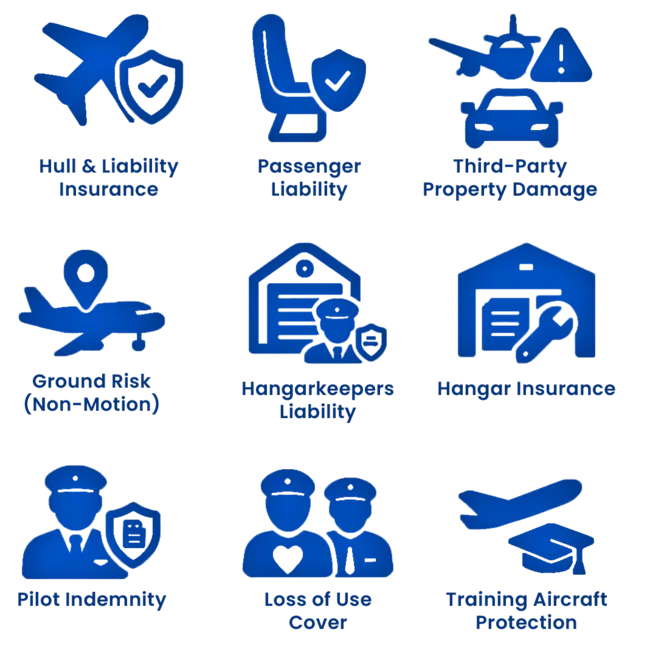
Beechcraft insurance policies can be structured to reflect private ownership, training operations, and complex commercial use. Coverage is tailored according to the aircraft’s role and exposure. Below is a list of the main types of coverage for Beechcraft aircraft:
▶ Hull Insurance (Flight, Taxiing, Ground Risks)
Hull insurance covers accidental physical damage to the aircraft while in flight, taxiing, parked, undergoing ground handling, or in transit. Cover can be arranged for “all risks” in motion and on the ground, or ground risks only where applicable. Agreed value policies are common for higher-value aircraft. They ensure clarity about the insured value in the event of a total loss.
▶ Liability Insurance
Liability insurance protects the operator against legal claims arising from third-party bodily injury or property damage caused by the aircraft. This includes damage to buildings, vehicles, other aircraft, or injuries to people on the ground. Policies cover legal defence costs in addition to settlement amounts, subject to the policy limit. For turboprops and charter operations, higher liability limits are typically recommended due to increased passenger capacity, higher operating weights, and greater financial exposure in the event of a serious incident.
▶ Passenger and Crew Liability
Passenger and crew liability extends protection to cover the injury or death of passengers and, where applicable, employed crew members. This is particularly important for multi-seat aircraft such as the King Air, where several passengers may be carried on each flight. Limits can be structured per passenger or as a combined single limit, depending on the operation. For commercial operators, passenger liability limits must align with regulatory and contractual requirements, including charter agreements.
▶ Loss of Use
Loss of use cover provides financial compensation when the aircraft is grounded due to a covered hull claim. For commercial operators, this can help offset lost charter revenue or contract penalties during repair periods. Indemnity is usually subject to a waiting period and a daily or aggregate limit. It does not replace hull cover but complements it by addressing income interruption rather than physical damage.
▶ Operational and Experience Requirements
Insurance for Beechcraft aircraft often includes pilot warranties and operational conditions. Insurers may require minimum total time, hours on type, multi-engine or turbine experience, and documented transition training before cover applies. For turboprops, formal simulator or type training is commonly mandated. Policies may also specify recency requirements to ensure pilots maintain currency. Failure to meet these conditions can affect claim validity, making compliance a critical part of risk management.
What Influences the Cost of Beechcraft Insurance?
Beechcraft aircraft insurance premiums reflect the unit’s value, the pilot’s capability, and operational exposure rather than a fixed rate per model.
- Aircraft Factors
- Pilot Factors
- Operational Factors
- Model, year, and hull value: The insured hull value is one of the strongest pricing drivers. A newer Beechcraft King Air 360 has significantly higher replacement and parts costs than a 1980s Bonanza, and insurers price for worst-case loss exposure. Pressurisation systems, retractable landing gear, de-icing equipment, and turbine engines all increase repair complexity. Even for older aircraft, well-maintained units with engine programs or recent refurbishments may justify higher agreed values, which then directly affect premium calculations.
- Avionics upgrades: Retrofit glass panels, WAAS-enabled GPS units, weather radar, TCAS, and autopilot upgrades increase both an aircraft’s value and repair cost following an incident. Avionics often require specialised technicians and manufacturer-approved parts. A lightning strike or hard landing that damages integrated systems can lead to extensive troubleshooting and component replacement. Insurers, therefore, assess declared avionics values carefully to ensure the hull sum insured reflects true replacement cost.
- Hangar vs tiedown storage: Storage arrangements materially affect ground-risk exposure. Hangared aircraft are protected from hailstorms, UV degradation, wind-blown debris, and vandalism. Outdoor tiedown aircraft face higher frequency claims for weather damage, control surface movement, and minor ground incidents. In hail-prone regions, insurers may apply higher deductibles or adjust premiums accordingly. Secure storage can demonstrate proactive risk management and influence underwriting terms.
- Pistons vs turboprops: Turboprop Beechcraft aircraft operate at higher speeds, altitudes, and weights than piston variants. Engine overhauls and propeller assemblies are substantially more expensive. Turbine aircraft are also more likely to be used for commercial purposes, increasing utilisation and passenger exposure. Insurers factor in higher claim severity potential, multi-crew requirements, and more complex systems when pricing turbine-powered aircraft compared to piston singles or twins.
- Total flight hours: A pilot’s total time spent in flight provides underwriters with a broad measure of experience and exposure to varied flying conditions. A pilot with 3,000 hours across multiple aircraft types is statistically less likely to make fundamental handling errors than a low-time pilot transitioning quickly into a high-performance Beechcraft. However, insurers also look beyond total time and assess how relevant that experience is to the aircraft being insured.
- Hours on type:
Time specifically spent flying Beechcraft aircraft (especially multi-engine or turbine variants) is heavily weighted. Aircraft like the Baron or King Air have performance characteristics that differ from basic trainers. Underwriters often apply minimum hours on type for solo command or may require supervised flying for new owners. Low time on type can result in higher premiums, training requirements, or pilot warranties.
- IFR or advanced ratings:
Many Beechcraft aircraft are routinely operated under instrument flight rules (IFR), particularly in Australia’s regional and commercial environments. An instrument rating, multi-engine endorsement, or turbine endorsement demonstrates formal training aligned with the aircraft’s operational capability. Insurers may view properly rated and current pilots more favourably, especially when the aircraft is equipped for IFR operations.
- Recency of experience:
The recency of a pilot’s experience matters because skill degrades without regular practice. Insurers typically review hours flown in the previous 90 days and 12 months. A pilot returning after extended inactivity may be required to complete refresher or transition training before coverage is activated. Active flying patterns generally correlate with lower perceived operational risk.
- Charter, training, private flying: Insurers price premiums according to how intensively the aircraft is used and who is operating it. Private recreational use usually attracts the lowest premiums due to limited utilisation and controlled passenger exposure. Charter operations increase flight hours, cycles, and liability exposure with fare-paying passengers. Training operations add repetitive take-offs and landings and the involvement of student pilots, which increases frequency risk.
- Remote-area strips: Operations into short, unsealed, or remote airstrips introduce additional hazards, such as wildlife strikes, uneven surfaces, limited emergency services, and variable weather reporting. For turbine aircraft conducting regional services, insurers may review strip length, surface type, and operator procedures. Frequent remote operations can influence deductibles or overall premium levels.
- Commercial mission profiles: Different commercial roles carry different exposures. Freight operations may involve night flying and strict schedules. Aeromedical services operate under time pressure and at diverse airstrips. Corporate transport may involve higher passenger expectations and reputational risk. Underwriters assess these mission profiles to determine how operational pressure and frequency affect overall exposure.
Beechcraft Insurance Cost (Indicative)
Beechcraft insurance premiums can vary considerably depending on the aircraft category, performance capability, and intended use. From high-performance Bonanzas to multi-engine Barons and turbine King Air variants, each model presents a different risk profile.
Note: The ranges below are rough estimates based on the typical general aviation insurance market; actual premiums vary widely based on hull value, pilot experience, location, use, and insurer.
| Beechcraft Aircraft Category | Example Models | Estimated Premium Range Per Annum (AUD) | Remarks |
|---|---|---|---|
| Single-Engine Piston | Bonanza G36 | $4,000 – $10,000 |
Higher performance complex single; premiums influenced by pilot experience, IFR use, and avionics configuration. Liability limits and agreed hull value are key pricing drivers. |
| Twin-Engine Piston |
Baron 58 / G58 Travel Air |
$6,000 – $15,000 |
Twin-engine piston exposure and higher hull values increase rates. Multi-engine rating and recent twin experience significantly affect insurance cost. |
| Twin-Engine Turboprop | King Air 90 / 200 / 350 | $20,000 – $80,000+ |
High hull values and greater passenger capacity increase exposure. Premiums driven by training requirements, operational profile (charter vs corporate), liability limits, and international operations. |
Need a price for insuring your Beechcraft?
Contact us today to receive a personalised insurance quote and expert guidance for your Beechcraft aircraft and operation.
➜ Learn more about Aircraft Insurance Costs
How to Get the Best Beechcraft Insurance in Australia
Choosing the right Beechcraft policy involves structuring cover appropriately rather than simply selecting the lowest premium.
▶ Work With a Specialist Aviation Broker (Not a General Insurer)
Aviation brokers understand aircraft systems, compliance and licensing requirements, and insurer expectations. This knowledge helps avoid coverage gaps and misclassification of complex aircraft.
▶ Compare Policies Through a Broker Who Has Access to Multiple Insurers
Different insurers assess Beechcraft risks differently. Having access to multiple markets allows for the comparison of terms, exclusions, deductibles, and pricing.
▶ Customise Your Coverage to Match Your Flying
Different operations involve various types of exposures. The accurate disclosure of usage, pilot experience, and modifications ensures policies respond correctly in the event of a claim.
▶ Review and Update Your Policies Regularly
Aircraft values, pilot hours, and operational profiles change. Regular reviews with your insurance provider help ensure your assets and operation get adequate protection and avoid under-insurance.

Why Choose AGL Aviation for Your Beechcraft Insurance
AGL Aviation focuses exclusively on aviation risk and understands the operational realities of Beechcraft aircraft across Australia, whether you’re operating in Perth, Melbourne, Brisbane, Adelaide, Sydney, Canberra, Darwin, or Tasmania.
- 30+ years of aviation insurance experience: Our experience spans private general aviation through to turbine-powered commercial fleets, providing informed advice on complex aircraft risks. We understand underwriting expectations, common claim scenarios, and how policy wording responds in real operational environments.
- Australia-wide aviation specialist broker: We work with Beechcraft operators across metropolitan, regional, and remote Australia, aligning cover with operating conditions. This includes our consideration of climate exposure, remote strip operations, and differing state-based commercial activity requirements.
- Access to multiple Australian and international insurers: Broad market access allows for the placement of higher-value or complex turbine risks that may not fit standard domestic markets. It also enables the comparison of liability limits, deductibles, exclusions, and pilot warranties across competing underwriters.
- Tailored advice for private, training, charter, and commercial operations: Policies are structured around real operations, pilot qualifications, and aircraft configuration rather than generic templates. This reduces the risk of coverage gaps and ensures policy conditions reflect how the aircraft is flown in reality.
- Fast claims support and personal service: When incidents occur, we assist directly with insurers and assessors to help minimise downtime and manage the claims process Clear communication and accurate documentation can significantly reduce delays and uncertainty during repairs.
Protect Your Beechcraft With AGL Aviation
Get a tailored Beechcraft insurance quote from us at AGL Aviation Insurance Brokers.
Protect your aircraft, passengers, and business with cover designed specifically for how your Beechcraft operates.
Speak directly with one of our aviation insurance experts. Contact us today!
Fill Out Our Form for Your Custom Aviation Insurance Quote Today
Frequently asked questions
Common Questions About Insuring Beechcraft Aircraft
Often, yes, particularly for multi-engine and turbine models. Higher hull values, complex systems, and commercial usage can increase Beechcraft insurance costs compared to basic single-engine trainers.
Yes, subject to underwriting approval. Insurers assess pilot turbine time, multi-crew experience, operational procedures, and maintenance programs before offering charter terms.
Yes, provided the training operation is disclosed, and instructor qualifications meet insurer requirements. Premiums reflect higher utilisation and student exposure.
Sudden accidental engine damage may be covered, subject to policy terms. Wear and tear, or mechanical failure without an insured event, is generally excluded.
Yes. Owner-flown business use can be included without triggering hire-and-reward classification, provided no revenue is generated from passenger carriage.
Didn’t find the answers to your questions? Don’t hesitate to contact us.