
Cessna Insurance Tailored to Your Needs
Tailored cover for Cessna owners, operators, flight schools and commercial fleets.
Cessna aircraft are a cornerstone of Australian general aviation. From weekend private flying and ab-initio training to charter, survey, and remote operations, these aircraft are flown hard, often daily, and in a wide range of operating environments. That flexibility is exactly why insurance for Cessna aircraft needs careful attention.
At AGL Aviation, we arrange insurance for Cessna owners and operators across Australia who want cover that reflects how their aircraft are actually used. We don’t rely on generic aviation policies or assumptions based on model names alone. Instead, we look at the full picture: aircraft type, pilot experience, mission profile, and operational base. The result is insurance that protects your aircraft, your people, and your business without unnecessary gaps or inflated premiums.
Insurance for the World’s Most Popular GA Aircraft
Cessna aircraft have earned their reputation through reliability, versatility, and widespread support. Models like the 172 and 182 are staples of flight training and private ownership, while the Caravan and Conquest are workhorses for charter, freight, and regional services. Their popularity means insurers understand them well. However, that doesn’t mean one policy fits every Cessna.
Insurance must reflect how the aircraft is flown. A privately owned C172 used for local VFR flights carries a different risk profile from the same model operating daily in circuit training. Pilot hours, recency, IFR capability, and operating environment all affect exposure. Even within the same model line, differences in avionics, engine configuration, and modifications matter.
AGL Aviation has years of experience with Cessna insurance for piston singles, light twins, and turbine types. We work with owners, flight schools, charter operators, aero clubs, and commercial fleets. That depth allows us to structure policies that match real-world operations rather than forcing aircraft into broad categories that don’t reflect actual risk.



Why Cessna Insurance is Essential
Cessna aircraft are dependable, but aviation risk never disappears. Proper Cessna insurance protects both the aircraft and the people relying on it.
▶ Protection against accidents, damage, and liability
Even routine operations carry exposure. Ground handling incidents, prop strikes, bird strikes, hangar damage, and runway excursions are common claims. Liability risks can be significant, particularly where passengers, students, or third parties are involved. The right insurance ensures these events don’t become financially devastating.
▶ Compliance with Australian aviation regulations
Commercial operators, flying schools, and charter providers must meet contractual and regulatory insurance requirements. Many airports, lessors, and financiers also require minimum liability limits. A compliant policy protects operating approvals and commercial relationships.
▶ Peace of mind for owners, pilots, and businesses
Aviation insurance allows operators to focus on flying and managing operations, not worrying about what happens if something goes wrong. Knowing your cover aligns with how you fly reduces uncertainty and helps protect your aircraft and your business’s long-term viability.
Models of Cessna We Typically Insure
Cessna’s range of aircraft spans entry-level trainers through to turbine aircraft used in demanding commercial roles. AGL Aviation regularly arranges cover across this spectrum, including legacy aircraft, modern glass-cockpit variants, and heavily modified platforms.
This section typically covers popular piston singles, such as the Cessna 150, 152, 172, 182, and 206; light twins including the 310, 340, and 402; and turbine aircraft like the Caravan and Conquest series.
Each model presents different underwriting considerations, from training intensity and engine configuration to payload, mission type, and hull value. Our approach reflects those differences rather than grouping aircraft solely by size or horsepower.
| Cessna Aircraft Category | Common Models | Typical Use & Coverage |
|---|---|---|
| Single-Engine Piston |
Cessna 150 / 152 Cessna 162 Skycatcher Cessna 172 Skyhawk Cessna 177 Cardinal Cessna 180 / 182 Skylane Cessna 185 Skywagon Cessna 206 / 207 |
• Ideal for private flying, training, and club operations. • Coverage available for flight schools, rental fleets, and private owners. • Options for hull, liability, passenger cover, and hangar or storage. |
| Multi-Engine Piston |
Cessna 310 Cessna 337 Skymaster Cessna 340 Cessna 401 / 402 Cessna 404 Cessna 414 Cessna 421 |
• Commonly used for charter, business transport, and light commercial work. • Coverage for private, commercial, and air-taxi operations. • Higher liability limits and commercial endorsements available. |
| Turboprop |
Cessna 208 / 208B Caravan Cessna C425 Conquest I Cessna C441 Conquest II |
• Suitable for passenger charter, freight, remote-area operations, and commercial missions. • Coverage for commercial operators, fleet owners, scheduled services, and aerial work. • Optional cover for cargo, remote-strip operations, and business use. |
What Cessna Insurance Can Cover
A well-built Cessna insurance policy does more than meet minimum requirements. It aligns the cover with aircraft use, the operational environment, and your business structure.
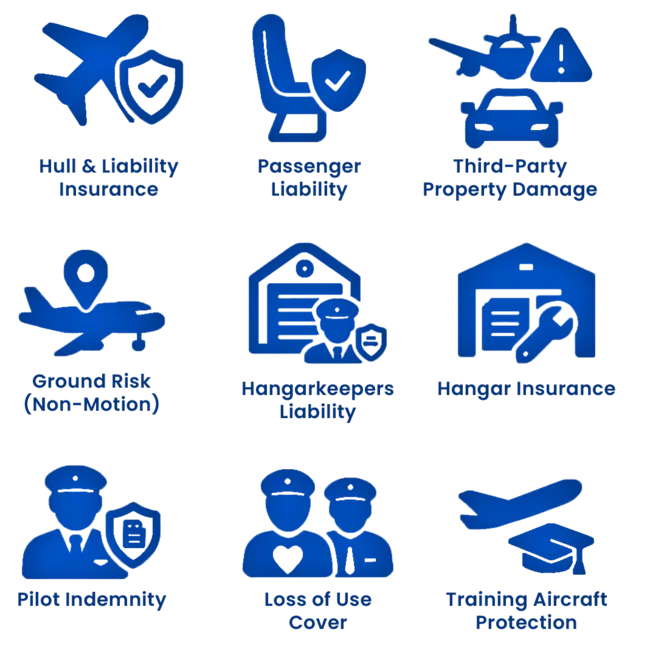
▶ Hull Insurance (Flight, Taxiing, Ground Risks)
Hull cover protects the insured value of the aircraft against physical damage on the ground and in the air. This includes incidents during taxi, take-off, landing, and hangar movements. Agreed hull values are set upfront, thereby reducing disputes in case of claims.
▶ Passenger and Third-Party Liability
Liability insurance covers legal responsibility for injury to passengers and damage to third-party property. Limits should reflect passenger numbers, the operating environment, and any contractual obligations. In training or charter settings, liability exposure can be substantial.
▶ Private, Business, and Commercial Use
Policies distinguish between private flying, business use, and commercial operations. Using an aircraft outside the declared category can void cover. What we do is ensure your policy aligns with how the aircraft is actually flown, not just how it was first insured.
▶ Training / Flight School Operations
Training aircraft come with high utilisation rates, frequent cycles, and pilots with limited experience. Insurance for flight schools must account for student pilots, instructor liability, circuit work, and multi-aircraft fleets. Ground school assets and simulators can also be included.
▶ Charter or Hire and Reward (If Eligible)
Charter operations involve higher exposure due to passenger carriage, schedule pressure, and operational frequency. Not all Cessna models qualify for hire and reward cover, and insurers assess pilot experience closely. At AGL Aviation, we structure policies that meet charter approval standards.
▶ Hangar, Tools, and Spare Parts
Many operators carry significant value outside the aircraft itself. Hangar contents, maintenance tools, spare engines, and parts can be insured to protect against theft, fire, or accidental damage.
▶ Avionics, Mods, and Equipment Upgrades
Modern avionics represent a large portion of an aircraft’s value. Glass cockpits, autopilots, ADS-B installations, and mission equipment should be properly declared and insured to avoid underinsurance.
▶ Optional Extensions: Loss of Use, Aerial Work, Survey, and Photography
Optional covers can include loss of use following an insured event, as well as endorsements for aerial work such as survey, photography, spotting, or observation roles. These extensions are structured around specific mission profiles.
What Influences the Cost of Cessna Insurance?
Cessna insurance premiums are shaped by how risk presents in a client’s day-to-day operations. Insurers look at the aircraft itself, who is flying it, and how and where it’s used to determine aviation insurance costs.
- Aircraft Factors
- Pilot Factors
- Operational Factors
- Model, year, and hull value: Insurers price risk partly on replacement cost and repair complexity. A newer Cessna with a higher agreed hull value costs more to insure than an older airframe, even if both are flown privately. So, when talking about the airplane insurance cost of Cessna 172s; that is, if you have more than one unit, you may not necessarily pay the same amount. Your Cessna 172 insurance costs for each may not be the same if, say, one is older or newer. Also, more complex models, such as pressurised or turbine aircraft, tend to attract higher premiums because of increased repair costs and issues with parts availability.
- Avionics upgrades: The addition of modern avionics, such as glass cockpits, digital autopilots, and integrated navigation systems, increases an aircraft’s insured value. While these upgrades are meant to improve situational awareness and safety, they can be expensive to repair or replace, so insurers need to factor this into the pricing.
- Hangar vs tiedown storage: Aircraft housed in secure hangars tend to be viewed as lower risk than those tied down outdoors. This is because hangared aircraft are less exposed to the elements, making them less prone to weather damage, wildlife strikes, and ground incidents. And this can translate into more favourable premiums.
- Pistons vs turboprops (higher risk profile): Turboprop Cessnas usually come with higher premiums because of greater hull values. They also come with more complex systems and tend to have more demanding operational roles besides being flown more frequently into regional or remote locations, and under commercial pressures that increase exposure.
- Total flight hours: A higher total flight time generally indicates greater experience and decision-making ability. Insurers often reward pilots with higher lifetime hours with lower premiums, particularly for complex or higher-performance aircraft.
- Hours on type: Time spent flying specific Cessna models matters. A pilot with 1,000 hours total but only 10 hours on type presents more risk than one with substantial experience in the same aircraft, especially for twins or turboprops.
- IFR or advanced ratings: Instrument ratings, multi-engine endorsements, and type-specific training can reduce perceived risk. These qualifications suggest structured training and competence in more demanding conditions, which insurers may reflect in pricing.
- Recency of experience: Pilots who fly regularly are generally considered lower risk than those who fly infrequently. Gaps in recent flight activity can lead to higher premiums or additional training requirements, particularly for commercial operations.
- Charter, training, private flying: Private recreational flying usually attracts the lowest premiums. Training and charter operations cost more to insure due to higher utilisation, student pilots, passenger liability, and increased exposure during take-offs and landings.
- Remote-area strips: Operations into short, unsealed, or remote airstrips increase risk due to limited infrastructure, variable surface conditions, and reduced access to emergency support. Insurers factor these conditions into both pricing and policy terms.
- Commercial mission profiles: Specialised missions, such as aerial survey, freight, or regional charter, introduce additional exposure. Payload variability, tight schedules, and operational pressure all influence how insurers assess risk and calculate premiums.
Typical Cessna Insurance Costs by Aircraft Category
Cessna insurance premiums vary widely depending on the aircraft category, complexity, and intended use. The table below provides indicative annual premium ranges for common Cessna models, along with key factors insurers consider when assessing risk and pricing cover.
| Cessna Aircraft Category | Example Models | Estimated Premium Range Per Annum (AUD) | Remarks |
|---|---|---|---|
| Trainer / Light single piston | C152 / C172 | $1,500 – $4,000 | Typically lower hull values and simpler systems; usage (training vs private) affects pricing |
| High-performance single piston | C182 / C206 | $2,500 – $6,500 | Higher power and value; premiums often influenced by total hours, retractable gear experience, and IFR use |
| Twin piston aircraft | C310 / C340 / C402 | $5,000 – $15,000 | More complex and higher exposure (multi-engine); pilot training and claims history are key drivers |
| Turboprop | Caravan / Conquest | $10,000 – $40,000 | Higher hull values and turbine complexity; commercial ops, remote strips, and freight/passenger use can increase premiums |
Need a price for insuring your Cessna?
Contact us today to receive a personalised insurance quote and expert guidance for your specific aircraft and operation.
➜ Learn more about Aircraft Insurance Costs
How to Get the Best Cessna Insurance in Australia
Acquiring the right Cessna insurance should never be about finding the cheapest policy. Your goal should be securing cover that reflects how your aircraft is flown, who flies it, and the real risks you face.
▶ Work With a Specialist Aviation Broker (Not a General Insurer)
Aviation insurance is highly technical. Specialist brokers understand Civil Aviation Safety Authority (CASA) requirements, aircraft systems, pilot qualifications, and operational risk in a way general insurers typically don’t. This expertise helps you avoid coverage gaps, inappropriate exclusions, or policy wording that doesn’t align with real-world flying scenarios.
▶ Compare Policies Through a Broker With Access to Multiple Insurers
Not all aviation insurers assess risk the same way. A broker with access to multiple Australian and international underwriters can compare terms, pricing, and conditions across the market, rather than forcing your aircraft into a single insurer’s risk appetite.
▶ Customise Your Coverage to Match Your Flying
Your policy should reflect actual use, not assumptions. Private touring, flight training, charter, or aerial work all carry different exposures. Customising cover ensures you’re protected for the flights you actually conduct, without paying for cover you don’t need or missing protection that’s necessary.
▶ Review and Update Your Policy Regularly
Aircraft values change, avionics get upgraded, pilots gain experience, and operations evolve. Regular policy reviews help ensure that insured values remain accurate and that new risks or operational changes are properly covered before a claim arises.

Why Choose AGL Aviation for Your Cessna Insurance
Deciding on the right aircraft insurance broker matters just as much as choosing the right policy. Since Cessna aircraft take on a wide range of roles, your insurance needs to reflect that reality.
- 30+ years of aviation insurance experience: AGL Aviation’s more-than-three-decades-long aviation insurance expertise ensures we understand perfectly how Cessna operations have evolved through the years, from traditional GA flying to modern training fleets and turbine operations. This level of experience helps us anticipate risk issues before they become claim problems.
- Australia-wide aviation specialist broker: From major airports to regional and remote airstrips, AGL Aviation works with Cessna owners and operators across Australia, including those located in Perth, Melbourne, Brisbane, Adelaide, Sydney, Canberra, Darwin, and Tasmania. This nationwide exposure gives us a clear understanding of how location, climate, and infrastructure affect underwriting decisions.
- Access to multiple Australian and international insurers: AGL Aviation doesn’t rely on a single market, so we have access to a broad panel of specialist underwriters. This enables us to identify risks that don’t fit standard templates. We also get to negotiate better terms and find solutions for complex or higher-value aircraft.
- Tailored advice for private, training, charter, and commercial operations: We know that no two Cessna operators fly the same way. This is why we make the effort to structure policies based on actual use. We consider pilot profiles and operational demands, so your coverage matches your flying rather than generic policy wording.
- Fast claims support and personal service: When an incident occurs, any type of delay costs time and money. AGL Aviation provides direct broker support during claims. We assist in managing documentation, liaise with insurers, and keep client downtime to a minimum while maintaining clear and timely communication.
You Might Also Be Interested In
Protect Your Cessna With Specialist Aviation Insurance
Get a Quote From AGL
Speak directly with an aviation insurance expert who understands your aircraft, your operation, and your risk profile.
Fill Out Our Form for Your Custom Aviation Insurance Quote Today
Frequently asked questions
Common Questions About Insuring a Cessna Aircraft
Aircraft insurance costs vary based on the model, its insured value, pilot experience, and use. Private piston Cessnas often start from around $1,500 per year, while complex, twin, or turbine aircraft used commercially can cost significantly more.
Most insurers require a minimum number of hours on specific Cessna models, particularly for twins or turboprops. If you’re low on type time, insurers may request supervised hours or approved transition training.
Yes. Flight schools can be insured, including coverage for student pilots, instructors, training sorties, and multi-aircraft fleets. Policies are structured to reflect high utilisation rates and the increased exposure that comes with ab-initio and advanced training.
Prop-strike and bird-strike damage are typically covered under hull insurance, subject to policy terms and excesses. Prompt reporting is essential, as insurers usually require inspections and maintenance action following these incidents.
Yes. Charter, hire-and-reward, and other commercial operations carry higher exposure than private flying. Increased flight hours, passenger liability, and operational pressure generally result in higher premiums and more detailed underwriting.
Didn’t find the answers to your questions? Don’t hesitate to contact us.